Improving a Competitor's Numbers (On Purpose) #55803
 giscus[bot]
Bot
giscus[bot]
Bot
Replies: 4 comments 11 replies

@franz1981 I will be away when you are back. this can wait mid september. thanks for the proposition. a bit of context in the meantime. we are starting to look at auto scaling. I am interested in figures comparing the different technologies we currently allow, namely quarkus, springboot and nodejs. since you provide already a nice framework for quarkus and springboot, I was wondering how much effort that would be to support nodejs. I remember in the early days, you had this slide with a density picture with jvm, node.js and go: we are starting to have the discussion internally about whether or not node.js is a good fit for auto-scaling. there is much to consider (e.g. functional coverage), but performance and density are 2 important requirements. I am wondering how easy that would be to fit node.js into this benchmark. |

|
@holly-cummins and @edeandrea too Let's say that we can still have conversations about it, but my experience as an engineer is that...it depends. |

|
We've had similar discussions about .NET. It would be really cool to do all of these benchmarks, and there's definitely demand for the numbers. But we're cautious about expanding past the core comparison that we started with, because of maintenance concerns – even maintaining the two/three versions of the app we have is a bit arduous. As soon as one version lags behind the others and misses a code change, the benchmark for that platform becomes useless. Lab time for execution is also a problem, since the more variants we have, the longer each one takes. |


|
I understand. I was not asking for you to do it, although if you did I would not mind ;-) note: I experienced 2 strange behaviors when trying to replicate the benchmark. I get: I was expecting env variables to be used. the second point was that my benchmark would die at some point. with the following explanation: if that makes sense I can create an issue. |
|
in the context of auto-scaling I am interested in density. If I look at the published results https://github.com/quarkusio/spring-quarkus-perf-comparison/#published-results I see:
|
|
I've got some plots cooking for density, for both high-load and low-load scenarios. One is merged but not publicised, and the other still needs to be merged. (My starting assumption is that in low load scenarios memory is what determines maximum density, and in high-load scenarios throughput determines density. Obviously, there's a messy middle where we can't say in advance which would be the limiting factor, and it might even be different for different frameworks, but I haven't gone to that level of complexity.) This is the plot for the high-load case. It ends up looking a bit like the throughput chart, in practice:quarkusio/benchmarks#484 The memory density chart is a bin packing chart, so visually more exciting: https://quarkus.io/benchmarks/tuned/spring-quarkus-perf-comparison-latest-tuned-density-by-rss-for-main-comparison-light.png |
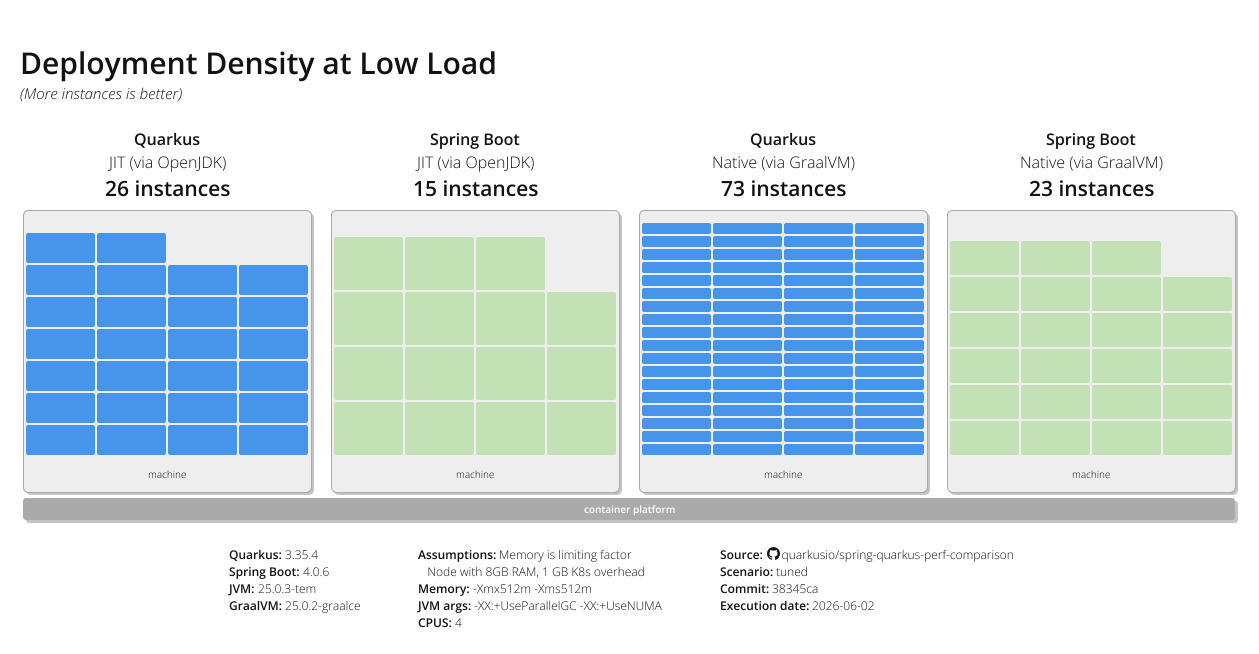
|
to illustrate what I was saying, I added different runtimes I combined some of the metrics with some weight to get a score. |
|
I am running on a WSL Ubuntu distro running on Windows 11, which is itself running as a VM, running in a private datacenter. I know this is not as solid as a physical dedicated perf machine, but that is what I have available at this point, and even if the numbers could be more accurate, hopefully there is still some value. the view of the WSL is: I do not have information on the underlying hardware at this point. |
|
No worries, just beware that the warmup period change dramatically with just 2 cores to the app as this article shows. The JIT compiler need time and some idleness to make sure both frameworks are fully compiled |
|
so should the warmup period be extended when running on 2 cores? even further with 1 core (which is the config I am running right now)? |
I have a pending PR which perform multiple warmups rounds because just hammering the app for longer sometime won't help; the pr is referenced in this article.
The tps are still different, and without using Shenandoah compact, Semeru/OpenJ9 compact, or any aggressive trimming, a JVM tends to use as much as given, not to stay compact - which is expected.
That's surprising but I won't make any guess without JFR data, see quarkusio/spring-quarkus-perf-comparison#521 |
|
I have created a discussion here: quarkusio/spring-quarkus-perf-comparison#712 |
|
what memory field do you report? when you calculate the TTFR, you do not apply warm up, right ? you start the process and send one request? in the measurement do you include launching the process plus getting the first response? |


Uh oh!
There was an error while loading. Please reload this page.
Improving a Competitor's Numbers (On Purpose)
Quarkus: Supersonic Subatomic Java
https://quarkus.io/blog/fairness-in-benchmarking/
All reactions