



An open-source AI agent that lives in your terminal.
中文 | Deutsch | français | 日本語 | Русский | Português (Brasil)
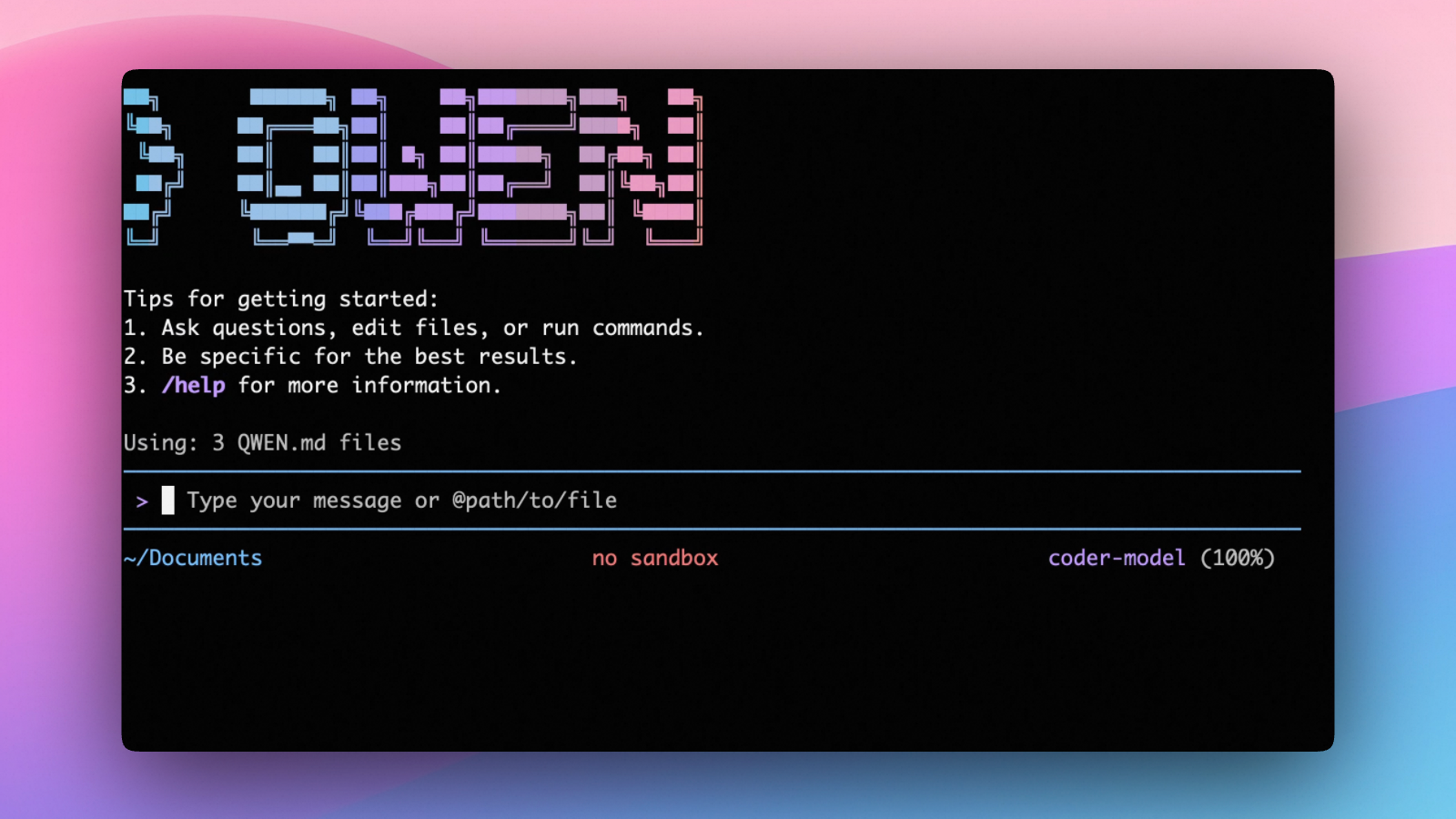
Qwen Code is an open-source AI agent for the terminal, optimized for Qwen3-Coder. It helps you understand large codebases, automate tedious work, and ship faster.
- OpenAI-compatible, OAuth free tier: use an OpenAI-compatible API, or sign in with Qwen OAuth to get 2,000 free requests/day.
- Open-source, co-evolving: both the framework and the Qwen3-Coder model are open-source—and they ship and evolve together.
- Agentic workflow, feature-rich: rich built-in tools (Skills, SubAgents, Plan Mode) for a full agentic workflow and a Claude Code-like experience.
- Terminal-first, IDE-friendly: built for developers who live in the command line, with optional integration for VS Code and Zed.
# Node.js 20+
curl -qL https://www.npmjs.com/install.sh | shnpm install -g @qwen-code/qwen-code@latestbrew install qwen-code# Start Qwen Code (interactive)
qwen
# Then, in the session:
/help
/authOn first use, you'll be prompted to sign in. You can run /auth anytime to switch authentication methods.
Example prompts:
What does this project do?
Explain the codebase structure.
Help me refactor this function.
Generate unit tests for this module.
Click to watch a demo video
Qwen Code supports two authentication methods:
- Qwen OAuth (recommended & free): sign in with your
qwen.aiaccount in a browser. - OpenAI-compatible API: use
OPENAI_API_KEY(and optionally a custom base URL / model).
Start qwen, then run:
/authChoose Qwen OAuth and complete the browser flow. Your credentials are cached locally so you usually won't need to log in again.
Environment variables (recommended for CI / headless environments):
export OPENAI_API_KEY="your-api-key-here"
export OPENAI_BASE_URL="https://api.openai.com/v1"  # optional
export OPENAI_MODEL="gpt-4o"                        # optional
For details (including .qwen/.env loading and security notes), see the authentication guide.
As an open-source terminal agent, you can use Qwen Code in four primary ways:
- Interactive mode (terminal UI)
- Headless mode (scripts, CI)
- IDE integration (VS Code, Zed)
- TypeScript SDK
cd your-project/
qwen
Run qwen in your project folder to launch the interactive terminal UI. Use @ to reference local files (for example @src/main.ts).
cd your-project/
qwen -p "your question"
Use -p to run Qwen Code without the interactive UI—ideal for scripts, automation, and CI/CD. Learn more: Headless mode.
Use Qwen Code inside your editor (VS Code and Zed):
Build on top of Qwen Code with the TypeScript SDK:
/help- Display available commands/clear- Clear conversation history/compress- Compress history to save tokens/stats- Show current session information/bug- Submit a bug report/exitor/quit- Exit Qwen Code
Ctrl+C- Cancel current operationCtrl+D- Exit (on empty line)Up/Down- Navigate command history
Learn more about Commands
Tip: In YOLO mode (
--yolo), vision switching happens automatically without prompts when images are detected. Learn more about Approval Mode
Qwen Code can be configured via settings.json, environment variables, and CLI flags.
- User settings:
~/.qwen/settings.json - Project settings:
.qwen/settings.json
See settings for available options and precedence.
| Agent | Model | Accuracy |
|---|---|---|
| Qwen Code | Qwen3-Coder-480A35 | 37.5% |
| Qwen Code | Qwen3-Coder-30BA3B | 31.3% |
Looking for a graphical interface?
- Gemini CLI Desktop A cross-platform desktop/web/mobile UI for Qwen Code
If you encounter issues, check the troubleshooting guide.
To report a bug from within the CLI, run /bug and include a short title and repro steps.
This project is based on Google Gemini CLI. We acknowledge and appreciate the excellent work of the Gemini CLI team. Our main contribution focuses on parser-level adaptations to better support Qwen-Coder models.