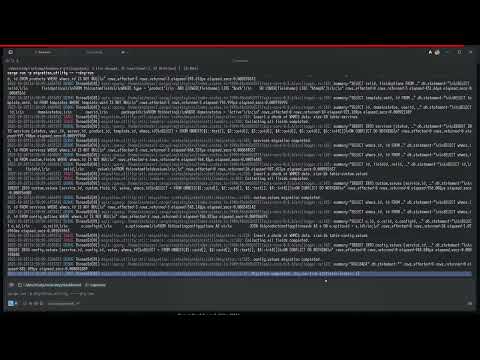
Build a complete WHMCS replacement: a Rust API orchestrating Proxmox VE, a React dashboard for server management, and a migration utility to transfer legacy data.
- WHMCS Testbed: Local legacy system simulation for migration testing
- Proxmox VE Testbed: Local virtualization environment for API integration
- Rust API: Server lifecycle orchestration with Proxmox integration
- React Dashboard: Modern web interface for server management
- Migration Utility: Command-line tool for WHMCS-to-PostgreSQL data transfer
- WHMCS Testbed: Local instance with sample users, server products, and complex Configurable Options (
RAM,CPU) and Custom Fields (OS templates,Datacenter locations) for migration testing - Proxmox VE Testbed: Running node with cloneable VM templates (Cloud-Init Ubuntu) accessible from the Rust API
- Architecture: Axum web framework, PostgreSQL persistence (SQLx/Diesel), structured logging (tracing)
- Core Features: JWT authentication, async server provisioning (202 Accepted), full lifecycle endpoints
- Proxmox Integration: Direct API integration for VM cloning, lifecycle management, and resource orchestration
- Stack: React with Vite, modern UI component library
- Features: JWT authentication, server listing with specs/status, live status updates via polling, direct server lifecycle actions
- Direct Database Extraction: The utility will connect directly to the WHMCS MySQL database to extract user and server data.
- Core Transformation Logic: The script's primary purpose is to prove it can migrate active users and their servers. The most critical task is to correctly extract and transform data from WHMCS's Configurable Options and Custom Fields into the new, structured PostgreSQL schema.
- Essential Safeguards: To prove the migration strategy is viable and safe, the utility must include:
- Idempotency: The script must be safe to run multiple times without creating duplicate data.
- A
--dry-runflag: This will print a summary of actions that would be taken, allowing for validation without committing any changes.
To validate the success of this build, a comprehensive test and benchmark suite covering both the frontend and backend is required.
- Backend Testing:
- Unit Tests: Primarily for the migration's transformation logic, ensuring the mapping from WHMCS fields is correct.
- Integration Tests: To verify the core API endpoints, including authentication, error handling, and successful orchestration of a server creation request.
- Frontend Testing:
- Component Tests: Basic tests (e.g., using Vitest/React Testing Library) must be included to verify the behavior of critical UI components like the login form and the server dashboard display.
- Professional Performance Benchmarking:
- API Performance: JWT authentication throughput, database query speeds, async task processing latency, and memory usage profiling
- Migration Performance: WHMCS transformation speed, bulk insert rates, memory efficiency, and idempotency validation
- Frontend Performance: React component render times, API response handling, and bundle size optimization
- End-to-End Validation: Complete workflow timing, concurrent user load testing, and connection pool performance
This stack includes the technologies explicitly mentioned and those implicitly required to successfully complete the project.
Core Application & Language
- Rust: The primary programming language for the API and migration utility.
- Tokio: The asynchronous runtime powering the
axumweb framework. - Axum: The web framework for building the core REST API.
- SQLx: The asynchronous SQL toolkit for Rust, used for interacting with PostgreSQL.
- Serde: The framework for serializing and deserializing Rust data structures, primarily for JSON API payloads.
- Clap: A command-line argument parser for building the standalone migration utility.
- Tracing: A framework for instrumenting Rust programs to collect structured, event-based diagnostic information.
Database Systems
- PostgreSQL: The target database for the new, modern application.
- MySQL: The source database used by the legacy WHMCS instance.
- SQL: Proficiency in both PostgreSQL and MySQL dialects is required.
Web & API Technologies
- RESTful API Design: Principles for creating clean, predictable web APIs.
- HTTP: Core understanding of methods (GET, POST), status codes (e.g., 200 OK, 202 Accepted, 401 Unauthorized), and headers.
- JSON (JavaScript Object Notation): The data format for API communication.
- JWT (JSON Web Tokens): The standard for stateless API authentication. Crates like
jsonwebtokenwould be used.
Legacy System & Environment
- WHMCS: The legacy PHP-based billing and automation platform.
- PHP: Basic understanding is helpful for navigating the WHMCS environment.
- LAMP Stack (Linux, Apache, MySQL, PHP): The typical environment for running WHMCS.
Development, Tooling & Design Patterns
- Docker & Docker Compose: For creating a reproducible local development environment that includes the WHMCS testbed, PostgreSQL, and the new Rust API.
- Cargo: Rust's build system and package manager.
- Git & GitHub: For version control.
sqlx-cli: A command-line utility for managing database migrations (creating, applying, reverting).- Mocking: Using traits and dependency injection to mock external services (
ProxmoxClient) for testing. Crates likewiremockare common. - Background Worker Pattern: A design pattern for offloading long-running tasks (like server provisioning) from the main API request-response cycle.
This translates the technology stack into the practical skills needed to execute the project.
1. Rust Backend Development
- Web API Construction: Proficiency in building robust, asynchronous REST APIs using
axum, including routing, state management, middleware, and error handling. - Database Interaction: Deep knowledge of using
sqlxfor type-safe, asynchronous database queries, transactions, and connection pooling. - Authentication & Authorization: Skill in implementing JWT-based authentication flows, including token generation, validation, and protecting endpoints.
- Asynchronous Processing: Ability to design and implement background job processing within an application, using
tokiotasks to handle long-running operations without blocking API responses. - CLI Application Development: Experience building sophisticated command-line tools in Rust using a library like
clapto handle arguments, flags, and subcommands.
2. Database Engineering & Data Migration
- Relational Database Modeling: The ability to design a clean, normalized PostgreSQL schema that effectively models the domain (users, servers, specs) and improves upon the legacy WHMCS structure.
- Complex Data Transformation: The critical skill of analyzing a legacy database schema (WHMCS) and writing transformation logic to map its data—especially complex, unstructured data from "Custom Fields"—into a new, structured schema.
- ETL (Extract, Transform, Load) Principles: Understanding the core concepts of data extraction from a source (MySQL), in-memory transformation (in Rust), and loading into a target (PostgreSQL).
- SQL Proficiency: Strong SQL skills in both MySQL and PostgreSQL to query the source data effectively and verify the migrated data in the target.
- Idempotent Scripting: The ability to write scripts that can be run multiple times with the same outcome, preventing data duplication or corruption.
3. DevOps & Systems Administration
- Containerization: Expertise in using Docker and Docker Compose to define, build, and run a multiservice local development environment.
- Legacy System Management: The practical ability to install, configure, and populate a PHP/MySQL application like WHMCS to serve as a realistic testbed.
- Database Migration Management: Proficiency with tools like
sqlx-clito manage the evolution of the database schema in a controlled, versioned manner.
4. Software Architecture & Quality Assurance
- Test-Driven Development (TDD): A strong discipline for writing unit tests for critical business logic (especially the data transformation rules) and integration tests for API endpoints.
- Mocking & Dependency Injection: The ability to design code using traits to decouple components, allowing for external services (like a hypervisor API) to be mocked during testing.
- Structured Logging: Skill in using the
tracinglibrary to produce meaningful, structured logs that are essential for debugging a distributed or asynchronous system. - This project is a full-stack server management platform designed to replace the core functionality of WHMCS. It features a Rust-based API for orchestrating a Proxmox VE instance and an interactive React frontend.
This project includes a suite of benchmarks to measure performance and memory efficiency.
Execution Time (Criterion)
To measure the speed of the data migration process, run the standard Criterion benchmarks. This will generate an HTML report in dashboard/target/criterion/report/index.html.
cargo bench --bench benchmarksMemory Efficiency (DHAT)
To profile the heap memory usage during the migration, run the custom memory benchmark. This will also create a report in dashboard/target/dhat-heap.json file for detailed analysis with dhat-viewer.
cargo bench --bench memoryBefore running the benchmarks for the first time, make the scripts executable:
chmod +x scripts/benchmark_api.sh
chmod +x scripts/profile_memory.sh
API Throughput (Oha)
The benchmark_api.sh script uses oha to measure request throughput for key API endpoints against a running server.
./scripts/benchmark_api.shMemory Usage (Valgrind/Massif)
This process requires two terminal tabs running concurrently.
# In tab 1, start the server under the memory profiler
./scripts/profile_memory.sh
# In tab 2, while the profiler is running, execute the load test to generate traffic
./scripts/benchmark_api.sh
# When the load test is finished, stop the profiler in **Tab 1** by pressing `Ctrl+C`
# Analyze the generated memory report located at `dashboard/target/massif.out`
ms_print target/massif.out