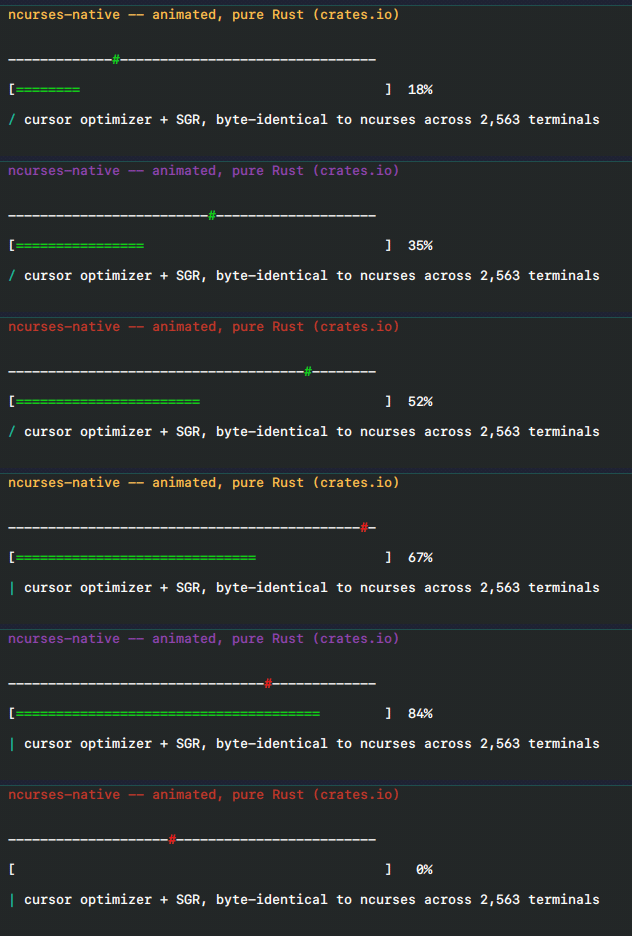
Live render of the published crate (the static frame is assets/ncurses-native.png).

A clean-room, dependency-free Rust reproduction of the observable terminal byte output of ncurses 6.4. The output engines are terminfo-driven and verified byte-for-byte against real ncurses across the entire compiled terminfo database — 2,563 terminal types, not just xterm. Reverse-engineered from captured behaviour, not ported from ncurses C source — there is zero ncurses C source in this repo.
#![forbid(unsafe_code)], std-only, no dependencies, ASCII-only source.
The output engines are measured byte-for-byte against real ncurses across the entire
2,563-entry compiled terminfo database (tools/db-coverage/sweep.py, run live —
not a cached number):
| engine | byte-exact across the DB |
|---|---|
cursor-movement optimizer (mvcur) |
2559 / 2563 — 99.84% |
doupdate (full screen update) |
2549 / 2563 — 99.45% |
| incremental update | 2536 / 2563 — 98.95% |
colour (setaf/setab, toggled, bce) |
2535 / 2563 — 98.91% |
SGR attributes (sgr/mode-caps) |
2345 / 2563 — 91.49% |
The infocmp decompiler and tic compiler are 100.000% byte-exact across the full
database (both -1 and -1 -x). A real curses C program (initscr/init_pair/
mvaddstr/attron/windows/pads/panel/menu/form/getch) linked against the native
C-ABI (crates/ncurses-cabi, libncurses_cabi.{so,a}) draws byte-identically to the
system libncursesw, and the cdylib is a working libtinfo.so.6 drop-in.
The remaining tails are understood and bounded (the SGR tail is dominated by the
obsolete magic-cookie xmc terminals); see docs/capabilities.md.
[dependencies]
ncurses-native = "0.1"
use ncurses_native::{mvcur, sgr_on, sgr_off, Attr};
// The cursor-movement optimizer picks the cheapest escape sequence, like ncurses.
let bytes = mvcur((0, 0), (5, 10)); // -> b"\x1b[5;10H"
std::io::Write::write_all(&mut std::io::stdout(), &bytes).unwrap();
// SGR attributes:
print!("{}bold{}", String::from_utf8_lossy(&sgr_on(Attr::Bold)),
String::from_utf8_lossy(&sgr_off()));Higher-level surfaces are available too: Window (cells/attrs/geometry), Screen
(doupdate-style updates), Terminfo (tigetstr/tparm/tputs/tgoto), colour and
key decoding. The macro-style C API maps to methods (getyx → win.getyx()).
This is a seed grown toward parity, not a finished library, and not a replacement for ncurses:
- The terminfo-driven engines (cursor optimizer,
doupdate, colour, attributes) and theinfocmp/tictools are verified against the admitted ncurses 6.4 oracle across the whole 2,563-entry terminfo database — thousands of terminal types — at the percentages in the table above (tools/db-coverage/sweep.py, re-runnable). The remaining few-percent tails are enumerated per-terminal, not hidden. - The one xterm-specific piece is the live-pty composite framing capture (
initscr…endwinwhole-stream), pinned toTERM=xterm, 80×24,C.UTF-8— proven by the receipts underreports/oracle/. Other ncurses builds are a non-claim. - It reproduces terminal output; functions with no terminal-output contract (interactive input reads, pure queries, global state) are classified, not byte-claimed.
- Wide-char/double-width breadth is in progress.
docs/capabilities.md— full court-backed capability detail, the C-ABI/panel/menu/form/tools story, and the parity bounds.docs/gap-ledger.md— the forensic gap ledger (every gap vs ncurses).docs/generated/port-parity.mdandport-parity-functions.md— the generated, freshness-gated public-C-API parity matrices (cargo xtask checkenforces freshness).docs/generated/claim-index.md— courts and receipts.
Apache-2.0. See LICENSE.