Bump edu.hm.hafner:codingstyle-pom from 5.39.0 to 5.40.0 #575
Quality Monitor

🚀 Integration Tests: 100% successful (143 passed, 7 skipped)
⛔ Architecture Tests: 100% successful (15 passed)
〰️ Line Coverage: 76% (720 missed lines)
➰ Branch Coverage: 67% (291 missed branches)
 CheckStyle: No warnings
 PMD: 2 warnings (normal: 2)
☕ Java Compiler: No warnings
 SpotBugs: No bugs
🐛 Error Prone: No bugs
🛡️ OWASP Dependency Check: 209 vulnerabilities (error: 17, high: 55, normal: 131, low: 6)
🌀 Cyclomatic Complexity: 1027 (total)
💭 Cognitive Complexity: 561 (total)
➿ N-Path Complexity: 1384 (total)
📏 Lines of Code: 12028 (total)
📝 Non Commenting Source Statements: 4051 (total)
🔗 Class Cohesion: 100.00% (maximum)
⚖️ Weight of Class: 100.00% (maximum)
🚦 Quality Gates
Overall Status: ❌ FAILURE
✅ Passed Gates
- ✅ Tests Success Rate: 100.00 >= 100.00
- ✅ Line Coverage: 76.00 >= 75.00
- ✅ Branch Coverage: 67.00 >= 65.00
- ✅ Potential Bugs: 0.00 <= 0.00
❌ Failed Gates
- ❌ Style Violations: 2.00 <= 0.00
Created by Quality Monitor v3.5.0 (#e4cc310)
Details
☀️ Quality Monitor
 Tests
Tests
| Icon | Name | Reports | Passed | Skipped | Failed | Tests |
|---|---|---|---|---|---|---|
|
Unit Tests | 28 | 185 | 0 | 0 | 185 |
| 🚀 | Integration Tests | 11 | 143 | 7 | 0 | 150 |
| ⛔ | Architecture Tests | 2 | 15 | 0 | 0 | 15 |
| Total | ➖ | 41 | 343 | 7 | 0 | 350 |
Skipped Tests
- io.jenkins.plugins.coverage.metrics.steps.GitForensicsITest#shouldVerifyQualityGate(Baseline, double, double)
- io.jenkins.plugins.coverage.metrics.steps.GitForensicsITest#shouldComputeDeltaInFreestyleJobOnDockerAgent
- io.jenkins.plugins.coverage.metrics.steps.GitForensicsITest#shouldComputeDeltaInPipelineOnDockerAgent(SourceCodeRetention, int)
- io.jenkins.plugins.coverage.metrics.source.DockerAgentSourceCodeITest#verifySourcesInWorkspaceRoot(boolean)
- io.jenkins.plugins.coverage.metrics.source.DockerAgentSourceCodeITest#verifySourcesInApprovedExternalFolder
- io.jenkins.plugins.coverage.metrics.source.DockerAgentSourceCodeITest#refuseSourceCodePaintingInNotApprovedExternalFolder
- io.jenkins.plugins.coverage.metrics.source.DockerAgentSourceCodeITest#verifySourcesInWorkspaceSubFolder(boolean)
⚠️ Style
| Icon | Name | Reports | Errors | High | Normal | Low | Total |
|---|---|---|---|---|---|---|---|
|
CheckStyle | 6 | 0 | 0 | 0 | 0 | 0 |
|
PMD | 6 | 0 | 0 | 2 | 0 | 2 |
| ☕ | Java Compiler | 1 | 0 | 0 | 0 | 0 | 0 |
| ➕ | Total | 13 | 0 | 0 | 2 | 0 | 2 |
🐛 Bugs
| Icon | Name | Reports | Errors | High | Normal | Low | Total |
|---|---|---|---|---|---|---|---|
|
SpotBugs | 2 | 0 | 0 | 0 | 0 | 0 |
| 🐛 | Error Prone | 1 | 0 | 0 | 0 | 0 | 0 |
| ➕ | Total | 3 | 0 | 0 | 0 | 0 | 0 |
🛡️ Vulnerabilities
| Icon | Name | Reports | Errors | High | Normal | Low | Total |
|---|---|---|---|---|---|---|---|
| 🛡️ | OWASP Dependency Check | 3 | 17 | 55 | 131 | 6 | 209 |
👣 Code Coverage
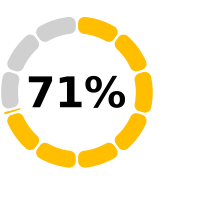
| Icon | Name | Covered % | Missed % |
|---|---|---|---|
| 〰️ | Line Coverage | 76 | 24 |
| ➰ | Branch Coverage | 67 | 33 |
| ➕ | Total Ø | 71 | 29 |
📐 Software Metrics
| Icon | Name | Total | Min | Max | Mean | Median |
|---|---|---|---|---|---|---|
| 🌀 | Cyclomatic Complexity | 1027 | 1 | 8 | 1.49 | 1 |
| 💭 | Cognitive Complexity | 561 | 0 | 13 | 0.72 | 0 |
| ➿ | N-Path Complexity | 1384 | 1 | 72 | 1.77 | 1 |
| 📏 | Lines of Code | 12028 | 1 | 64 | 10.50 | 1 |
| 📝 | Non Commenting Source Statements | 4051 | 1 | 31 | 3.87 | 1 |
| 🔗 | Class Cohesion | 100.00% | 0.00% | 100.00% | 11.60% | 0.00% |
| ⚖️ | Weight of Class | 100.00% | 0.00% | 100.00% | 71.19% | 0.00% |
🚦 Quality Gates
Overall Status: ❌ FAILURE
✅ Passed Gates
- ✅ Tests Success Rate: 100.00 >= 100.00
- ✅ Line Coverage: 76.00 >= 75.00
- ✅ Branch Coverage: 67.00 >= 65.00
- ✅ Potential Bugs: 0.00 <= 0.00
❌ Failed Gates
- ❌ Style Violations: 2.00 <= 0.00
Annotations
Check warning on line 76 in ui-tests/src/main/java/io/jenkins/plugins/coverage/CoverageReport.java
 github-actions / Quality Monitor - Quality gates failed
PMD: EnumComparison
Enums should be compared using ==.
Check warning on line 85 in ui-tests/src/main/java/io/jenkins/plugins/coverage/CoverageReport.java
github-actions / Quality Monitor - Quality gates failed
PMD: EnumComparison
Enums should be compared using ==.
Check warning on line 1 in cli-2.516.3.jar (shaded: net.i2p.crypto:eddsa:0.3.0)
github-actions / Quality Monitor - Quality gates failed
OWASP Dependency Check: CVE-2020-36843
The implementation of EdDSA in EdDSA-Java (aka ed25519-java) through 0.3.0 exhibits signature malleability and does not satisfy the SUF-CMA (Strong Existential Unforgeability under Chosen Message Attacks) property. This allows attackers to create new valid signatures different from previous signatures for a known message.
Check warning on line 1 in commons-jelly-tags-fmt-1.1-jenkins-20250616.jar
github-actions / Quality Monitor - Quality gates failed
OWASP Dependency Check: CVE-2018-1000052
fmtlib version prior to version 4.1.0 (before commit 0555cea5fc0bf890afe0071a558e44625a34ba85) contains a Memory corruption (SIGSEGV), CWE-134 vulnerability in fmt::print() library function that can result in Denial of Service. This attack appear to be exploitable via Specifying an invalid format specifier in the fmt::print() function results in a SIGSEGV (memory corruption, invalid write). This vulnerability appears to have been fixed in after commit 8cf30aa2be256eba07bb1cefb998c52326e846e7.
Check warning on line 1 in commons-lang-2.6.jar
github-actions / Quality Monitor - Quality gates failed
OWASP Dependency Check: CVE-2025-48924
Uncontrolled Recursion vulnerability in Apache Commons Lang.

This issue affects Apache Commons Lang: Starting with commons-lang:commons-lang 2.0 to 2.6, and, from org.apache.commons:commons-lang3 3.0 before 3.18.0.

The methods ClassUtils.getClass(...) can throw StackOverflowError on very long inputs. Because an Error is usually not handled by applications and libraries, a
StackOverflowError could cause an application to stop.

Users are recommended to upgrade to version 3.18.0, which fixes the issue.

Sonatype's research suggests that this CVE's details differ from those defined at NVD. See https://ossindex.sonatype.org/vulnerability/CVE-2025-48924 for details
Check warning on line 1 in jenkins-core-2.516.3.jar: jenkins.exe
github-actions / Quality Monitor - Quality gates failed
OWASP Dependency Check: CVE-2016-9299
The remoting module in Jenkins before 2.32 and LTS before 2.19.3 allows remote attackers to execute arbitrary code via a crafted serialized Java object, which triggers an LDAP query to a third-party server.
Check warning on line 1 in jenkins-core-2.516.3.jar: jenkins.exe
github-actions / Quality Monitor - Quality gates failed
OWASP Dependency Check: CVE-2017-1000353
Jenkins versions 2.56 and earlier as well as 2.46.1 LTS and earlier are vulnerable to an unauthenticated remote code execution. An unauthenticated remote code execution vulnerability allowed attackers to transfer a serialized Java `SignedObject` object to the Jenkins CLI, that would be deserialized using a new `ObjectInputStream`, bypassing the existing blacklist-based protection mechanism. We're fixing this issue by adding `SignedObject` to the blacklist. We're also backporting the new HTTP CLI protocol from Jenkins 2.54 to LTS 2.46.2, and deprecating the remoting-based (i.e. Java serialization) CLI protocol, disabling it by default.
Check warning on line 1 in jenkins-core-2.516.3.jar: jenkins.exe
github-actions / Quality Monitor - Quality gates failed
OWASP Dependency Check: CVE-2018-1000861
A code execution vulnerability exists in the Stapler web framework used by Jenkins 2.153 and earlier, LTS 2.138.3 and earlier in stapler/core/src/main/java/org/kohsuke/stapler/MetaClass.java that allows attackers to invoke some methods on Java objects by accessing crafted URLs that were not intended to be invoked this way.
Check warning on line 1 in jenkins-core-2.516.3.jar: jenkins.exe
github-actions / Quality Monitor - Quality gates failed
OWASP Dependency Check: CVE-2021-21690
Agent processes are able to completely bypass file path filtering by wrapping the file operation in an agent file path in Jenkins 2.318 and earlier, LTS 2.303.2 and earlier.
Check warning on line 1 in jenkins-core-2.516.3.jar: jenkins.exe
github-actions / Quality Monitor - Quality gates failed
OWASP Dependency Check: CVE-2021-21691
Creating symbolic links is possible without the 'symlink' agent-to-controller access control permission in Jenkins 2.318 and earlier, LTS 2.303.2 and earlier.
Check warning on line 1 in jenkins-core-2.516.3.jar: jenkins.exe
github-actions / Quality Monitor - Quality gates failed
OWASP Dependency Check: CVE-2021-21692
FilePath#renameTo and FilePath#moveAllChildrenTo in Jenkins 2.318 and earlier, LTS 2.303.2 and earlier only check 'read' agent-to-controller access permission on the source path, instead of 'delete'.
Check warning on line 1 in jenkins-core-2.516.3.jar: jenkins.exe
github-actions / Quality Monitor - Quality gates failed
OWASP Dependency Check: CVE-2021-21693
When creating temporary files, agent-to-controller access to create those files is only checked after they've been created in Jenkins 2.318 and earlier, LTS 2.303.2 and earlier.
Check warning on line 1 in jenkins-core-2.516.3.jar: jenkins.exe
github-actions / Quality Monitor - Quality gates failed
OWASP Dependency Check: CVE-2021-21694
FilePath#toURI, FilePath#hasSymlink, FilePath#absolutize, FilePath#isDescendant, and FilePath#get*DiskSpace do not check any permissions in Jenkins 2.318 and earlier, LTS 2.303.2 and earlier.
Check warning on line 1 in jenkins-core-2.516.3.jar: jenkins.exe
github-actions / Quality Monitor - Quality gates failed
OWASP Dependency Check: CVE-2021-21696
Jenkins 2.318 and earlier, LTS 2.303.2 and earlier does not limit agent read/write access to the libs/ directory inside build directories when using the FilePath APIs, allowing attackers in control of agent processes to replace the code of a trusted library with a modified variant. This results in unsandboxed code execution in the Jenkins controller process.
Check warning on line 1 in jenkins-core-2.516.3.jar: jenkins.exe
github-actions / Quality Monitor - Quality gates failed
OWASP Dependency Check: CVE-2024-23897
Jenkins 2.441 and earlier, LTS 2.426.2 and earlier does not disable a feature of its CLI command parser that replaces an '@' character followed by a file path in an argument with the file's contents, allowing unauthenticated attackers to read arbitrary files on the Jenkins controller file system.
Check warning on line 1 in jenkins-core-2.516.3.jar: jenkins.exe
github-actions / Quality Monitor - Quality gates failed
OWASP Dependency Check: CVE-2021-21685
Jenkins 2.318 and earlier, LTS 2.303.2 and earlier does not check agent-to-controller access to create parent directories in FilePath#mkdirs.
Check warning on line 1 in jenkins-core-2.516.3.jar: jenkins.exe
github-actions / Quality Monitor - Quality gates failed
OWASP Dependency Check: CVE-2021-21687
Jenkins 2.318 and earlier, LTS 2.303.2 and earlier does not check agent-to-controller access to create symbolic links when unarchiving a symbolic link in FilePath#untar.
Check warning on line 1 in jenkins-core-2.516.3.jar: jenkins.exe
github-actions / Quality Monitor - Quality gates failed
OWASP Dependency Check: CVE-2021-21689
FilePath#unzip and FilePath#untar were not subject to any agent-to-controller access control in Jenkins 2.318 and earlier, LTS 2.303.2 and earlier.
Check warning on line 1 in jenkins-core-2.516.3.jar: jenkins.exe
github-actions / Quality Monitor - Quality gates failed
OWASP Dependency Check: CVE-2021-21697
Jenkins 2.318 and earlier, LTS 2.303.2 and earlier allows any agent to read and write the contents of any build directory stored in Jenkins with very few restrictions.
Check warning on line 1 in jenkins-core-2.516.3.jar: jenkins.exe
github-actions / Quality Monitor - Quality gates failed
OWASP Dependency Check: CVE-2017-1000354
Jenkins versions 2.56 and earlier as well as 2.46.1 LTS and earlier are vulnerable to a login command which allowed impersonating any Jenkins user. The `login` command available in the remoting-based CLI stored the encrypted user name of the successfully authenticated user in a cache file used to authenticate further commands. Users with sufficient permission to create secrets in Jenkins, and download their encrypted values (e.g. with Job/Configure permission), were able to impersonate any other Jenkins user on the same instance.
Check warning on line 1 in jenkins-core-2.516.3.jar: jenkins.exe
github-actions / Quality Monitor - Quality gates failed
OWASP Dependency Check: CVE-2017-1000356
Jenkins versions 2.56 and earlier as well as 2.46.1 LTS and earlier are vulnerable to an issue in the Jenkins user database authentication realm: create an account if signup is enabled; or create an account if the victim is an administrator, possibly deleting the existing default admin user in the process and allowing a wide variety of impacts.
Check warning on line 1 in jenkins-core-2.516.3.jar: jenkins.exe
github-actions / Quality Monitor - Quality gates failed
OWASP Dependency Check: CVE-2017-1000393
Jenkins 2.73.1 and earlier, 2.83 and earlier users with permission to create or configure agents in Jenkins could configure a launch method called 'Launch agent via execution of command on master'. This allowed them to run arbitrary shell commands on the master node whenever the agent was supposed to be launched. Configuration of this launch method now requires the Run Scripts permission typically only granted to administrators.
Check warning on line 1 in jenkins-core-2.516.3.jar: jenkins.exe
github-actions / Quality Monitor - Quality gates failed
OWASP Dependency Check: CVE-2017-2608
Jenkins before versions 2.44, 2.32.2 is vulnerable to a remote code execution vulnerability involving the deserialization of various types in javax.imageio in XStream-based APIs (SECURITY-383).
Check warning on line 1 in jenkins-core-2.516.3.jar: jenkins.exe
github-actions / Quality Monitor - Quality gates failed
OWASP Dependency Check: CVE-2018-1999001
A unauthorized modification of configuration vulnerability exists in Jenkins 2.132 and earlier, 2.121.1 and earlier in User.java that allows attackers to provide crafted login credentials that cause Jenkins to move the config.xml file from the Jenkins home directory. If Jenkins is started without this file present, it will revert to the legacy defaults of granting administrator access to anonymous users.
Check warning on line 1 in jenkins-core-2.516.3.jar: jenkins.exe
github-actions / Quality Monitor - Quality gates failed
OWASP Dependency Check: CVE-2019-10384
Jenkins 2.191 and earlier, LTS 2.176.2 and earlier allowed users to obtain CSRF tokens without an associated web session ID, resulting in CSRF tokens that did not expire and could be used to bypass CSRF protection for the anonymous user.