An autonomous vehicle prediction system that forecasts steering angles and vehicle speeds 100-500ms into the future from camera footage and current vehicle state.
|
|
|
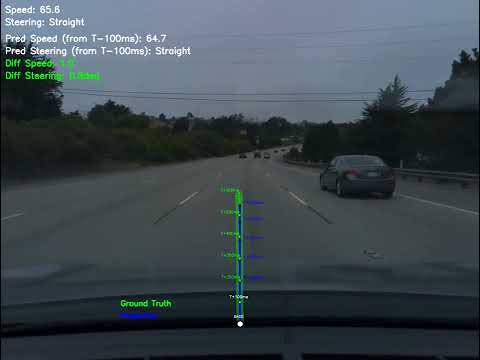
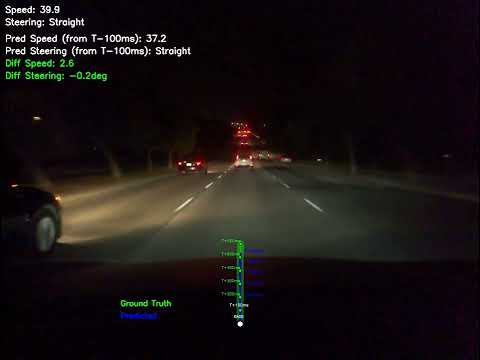
Finished training on 09/09/2025 (My Bday!), next steps are evaluation + simulation + intergration with openpilot.
Issues I ran into and learnt from are in issues.txt.
- CV Pipeline: Modified ResNet18 with 6-channel input for frame pairs (current + past)
- Frame Pairing: Stacked current+past (T-100ms) frame pairs as input for the GRU
- Temporal Modeling: 2-layer GRU (256 hidden units) with persistent state for streaming inference
- Multi-task Output: Joint prediction of steering angles and vehicle speeds
- Data Pipeline: Custom windowing system for efficient processing of 107.5GB Comma2k19 dataset (33 hrs of highway driving footage), smart shuffling too
- Dynamic Loss Weighting: Adaptive balancing between steering and speed objectives during training
- Streaming Design: GRU hidden states persist between predictions for real-time deployment
- Production Ready: Complete checkpointing system with resumable training and model exports. Dockerized for training on the cloud too (GCP)
Architecture:
- CNN Backbone: ResNet18 (pre-trained) with modified 6-channel input layer
- Temporal Model: 2-layer GRU (256 hidden units) for sequential processing
- Input: 20-frame sequences (1 second) with frame pairs T and T-100ms, with current steering and speed values
- Output: 5 future predictions for steering angle and speed (T+100ms to T+500ms)
Training Metrics:
- Total Epochs: 50 (completed successfully)
- Best Model: Epoch 48 with validation loss of 0.0014
- Final Performance:
- Training Loss: 0.0002 (Steering: 0.0001, Speed: 0.0001)
- Validation Loss: 0.0016 (Steering: 0.0011, Speed: 0.0000)
- Training Split: ~20 epochs on GCP, ~30 epochs locally with my gaming PC (like 2 weeks of loud fans spinning at night)
One Python entrypoint for all environments: python -m src.training.train.
configs/default.yaml(shared defaults)configs/local.yaml(your machine)configs/cloud.yaml(Vertex AI)
Precedence: default.yaml < profile (local/cloud or custom YAML) < environment variables < CLI flags.
-
Local (host Python):
python -m src.training.train --config local --dataset-path /path/to/data
-
Local (Docker):
docker build -t my-av .docker run --rm -v /path/to/data:/data my-av --config local --dataset-path /data
-
Cloud (Vertex AI UI with your Artifact Registry image):
- Set the container image built from this repo.
- Enable Cloud Storage FUSE for your bucket so it is mounted inside the container at
/gcs/<bucket>/.... - In Job Args, pass training flags, e.g.:
--config cloud --dataset-path gs://your-bucket/data --epochs 50 --batch-size 32 --num-workers 4. - Note: The code uses standard file operations, so either enable Cloud Storage FUSE or modify the code to use
gcsfsfor directgs://access.
--config local|cloud|/path/to/config.yaml--dataset-path PATH(supportsgs://with Cloud Storage FUSE enabled)--mode train|test(default:train)--epochs N(default: 50 fortrain, 10 fortestif not specified)--batch-size N(default: 20)--num-workers N(default: 2)--window-size N(default: 20)--checkpoint-dir DIR(default:checkpoints)--model-dir DIR(default:models)--log-dir DIR(default:logs)
AV_DATASET_PATH→data.dataset_pathAV_NUM_WORKERS→data.num_workersAV_BATCH_SIZE→train.batch_sizeAV_EPOCHS→train.epochsAV_DEVICE→runtime.deviceAV_LOG_INTERVAL→runtime.log_interval
Outputs are written to checkpoints/, models/, and logs/ by default.