Professional HDR Mathematical Animation Generator
Generate stunning 4K HDR cosmic visualizations using mathematical spiral dynamics with JIT-optimized performance.


Sample Animation (HDR):
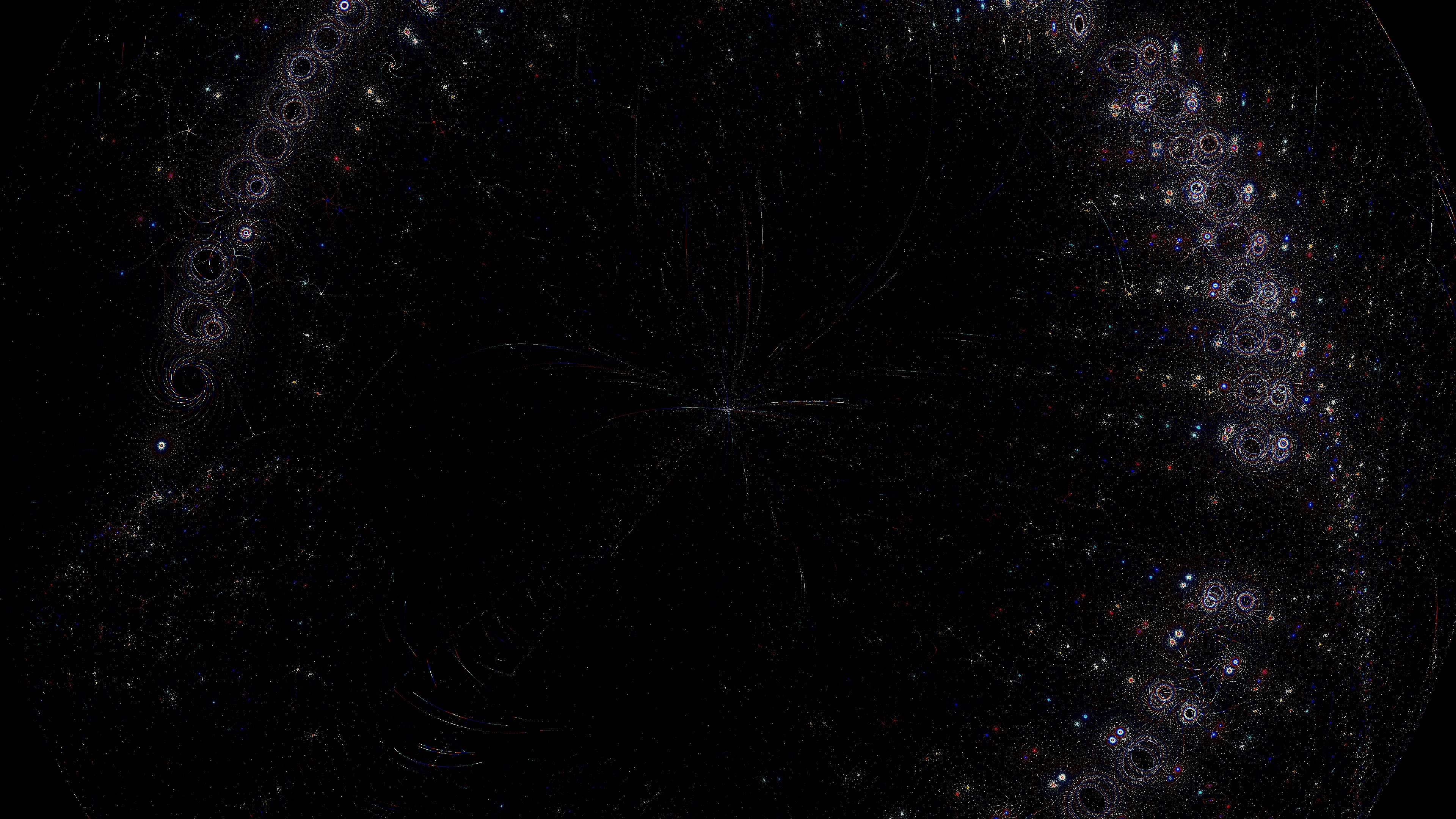

Click image to view HDR animation (works best on HDR-capable displays)
Lux Spiral Cosmos transforms mathematical equations into mesmerizing cosmic animations through:
- Mathematical Beauty: Coupled sine/cosine dynamical systems create organic spiral patterns
- HDR Excellence: True 16-bit Rec. 2020 color gamut with PQ tone mapping for 4000+ nit displays
- JIT Performance: Numba-optimized computation achieving 6M+ iterations/second (22x speedup)
- Professional Output: 4K resolution with FFmpeg-ready HDR video encoding
- 4K HDR Rendering: Native 3840×2160 with 16-bit TIFF output
- Mathematical Continuity: Frame-to-frame state persistence for smooth evolution
- Dynamic Spiral Sizing: Configurable pulsing effects and size modulation
- Preset System: JSON-based configurations for instant style switching
- Performance Monitoring: Detailed timing analysis and optimization metrics
- 22x Speed Improvement: JIT compilation reduces render time from 15s to 0.7s per frame
- Memory Efficient: ~100MB RAM usage during processing
- Scalable: From 1080p quick previews to 4K production renders
- HDR Brilliance: 1000-4000 nits peak brightness for blazing cosmic cores
- Wide Color Gamut: Rec. 2020 color space for impossible-on-sRGB colors
- Deep Space Blacks: True 0.01 nit darkness for dramatic contrast
- Smooth Animation: Deterministic mathematical evolution between frames
git clone https://github.com/luxardolabs/lux-spiral-cosmos.git
cd lux-spiral-cosmos
pip install -r requirements.txt# Use the default preset (matches original settings)
python cosmic_generator.py original_settings
# Try different presets
python cosmic_generator.py cosmic_intense
python cosmic_generator.py giant_spirals
# Enable debug mode for performance analysis
python cosmic_generator.py original_settings --debug# The generator provides the exact FFmpeg command needed:
ffmpeg -r 24 -i frames_original_settings_20250602_183755/frame_%04d.tiff \
-c:v libx265 -pix_fmt yuv420p10le \
-color_primaries bt2020 -color_trc smpte2084 -colorspace bt2020nc \
-x265-params 'hdr-opt=1:repeat-headers=1:colorprim=bt2020:transfer=smpte2084:colormatrix=bt2020nc' \
hdr_animation_original_settings_20250602_183755.mp4| Preset | Description | Characteristics |
|---|---|---|
original_settings |
Exact replica of development settings - DEFAULT | Balanced 4K HDR with subtle spiral pulsing |
cosmic_gentle |
Soft, meditative spirals | Gentle pulsing, lower brightness, peaceful |
cosmic_intense |
Dramatic HDR experience | 4000 nits peak, rapid pulses, vivid colors |
tiny_details |
High-resolution intricate patterns | 3000 density, fine spiral structures |
giant_spirals |
Massive spiral structures | Huge patterns, slow evolution, dramatic scale |
rainbow_chaos |
Fast color cycling chaos | Rapid rainbow shifts, chaotic dynamics |
Edit config_presets.json to modify any preset:
{
  "presets": {
    "my_custom_preset": {
      "description": "My custom cosmic animation",
      "video": {
        "width": 3840, "height": 2160,
        "num_frames": 240, "fps": 24
      },
      "hdr": {
        "max_nits": 4000,
        "cosmic_core_boost": 5.0
      },
      "mathematical": {
        "n": 2000,
        "r_denominator": 125,
        "time_speed": 0.01,
        "scale_factor": 700
      },
      "spiral_pulse": {
        "size_min": 0.98, "size_max": 1.02,
        "pulse_speed": 2.0
      },
      "colors": {
        "speed": 2, "saturation": 1.5,
        "red_base": 0.3, "red_variation": 0.7,
        "green_base": 0.2, "green_variation": 0.8,
        "blue_base": 0.5, "blue_variation": 0.8
      }
    }
  }
}n: Point density (1000=balanced, 2000=detailed, 3000=ultra-fine)r_denominator: Spiral tightness (50=loose, 125=balanced, 300=tight)time_speed: Evolution rate (0.01=slow, 0.05=normal, 0.1=fast)scale_factor: Pattern size (400=small, 700=screen-filling, 1000=oversized)
spiral_pulse: Dynamic size modulation (0.5-3.0 range creates dramatic effects)max_nits: HDR peak brightness (1000=standard, 4000=premium displays)cosmic_core_boost: Brightness multiplier for pattern centers (1.0-10.0)
saturation: Color intensity (1.0=natural, 2.0=vivid, 3.0=extreme)speed: Color cycling rate (1=slow, 5=fast, 10=strobing)- Base/Variation: Fine-tune individual color channels (0.0-1.0 range)
The core animation is generated by a coupled dynamical system:
u = sin(i + v) + sin(r * i + x)
v = cos(i + v) + cos(r * i + x)
x = u + t
Where:
i, j: Iteration indices creating the base patternr: Controls spiral frequency and tightnesst: Time parameter providing smooth evolution- State (
x, u, v) carries forward between frames for continuity
- Mathematical Computation: JIT-compiled spiral generation
- Color Space: sRGB → Rec. 2020 wide gamut conversion
- HDR Mapping: PQ (Perceptual Quantizer) tone curve application
- Output: 16-bit TIFF with proper HDR metadata
- Numba JIT: Machine code compilation for inner loops
- Type Specialization: Separate 8-bit/16-bit code paths
- Memory Efficiency: Minimal allocations, cache-friendly access
- Vectorization Ready: Architecture supports future SIMD optimization
| Configuration | Render Time | Iterations/sec | Speedup |
|---|---|---|---|
| Python (original) | 14.7s/frame | 277K | 1x baseline |
| Numba JIT | 0.97s/frame | 6.1M | 22x faster |
- 1080p: ~0.25s per frame
- 4K: ~0.97s per frame
- n=1000: ~0.5s per frame
- n=3000: ~2.1s per frame
Total Animation Times:
- 240 frames @ 4K: 3.9 minutes (was 59 minutes)
- 120 frames @ 1080p: 30 seconds
- HDR10-compatible display (1000+ nits peak brightness)
- Wide color gamut support (DCI-P3 minimum, Rec. 2020 preferred)
- HDR video player (VLC, MPV, or native TV apps)
- Proper HDMI 2.1 or DisplayPort 1.4+ connection
- ✅ LG OLED C/G series (4000 nits peak)
- ✅ Samsung QLED (2000+ nits)
- ✅ Apple Pro Display XDR (1600 nits)
- ✅ Most modern HDR TVs
- Standard displays show reduced dynamic range
- Still visually appealing but without HDR "wow" factor
- 8-bit PNG output available for standard workflows
lux-spiral-cosmos/
├── cosmic_generator.py      # Main generator class and CLI
├── config_manager.py        # Configuration management
├── jit_core.py             # JIT-optimized mathematical core
├── config_presets.json     # Preset configurations
├── requirements.txt        # Python dependencies
├── README.md              # This documentation
└── __init__.py            # Package initialization
cosmic_generator.py: Main orchestration, rendering pipeline, user interfaceconfig_manager.py: JSON loading, validation, preset management, FFmpeg commandsjit_core.py: Numba-compiled mathematical functions for maximum performanceconfig_presets.json: User-editable preset configurations
python cosmic_generator.py original_settings --debugProvides detailed performance analysis:
=== FRAME 1 DEBUG METRICS ===
Total time: 0.973s
Setup time: 0.000s (0.0%)
Math time (JIT): 0.654s (67.2%)
Save time: 0.319s (32.8%)
Total iterations: 4,000,000
Pixels processed: 3,261,955
Iterations per second: 6,106,519
Time per iteration: 0.16 microseconds
- Type hints throughout for better IDE support
- Modular architecture for easy maintenance
- Professional logging with configurable verbosity
- Error handling with meaningful messages
- Performance monitoring built-in
The modular design makes it easy to:
- Add new mathematical systems in
jit_core.py - Create new presets in
config_presets.json - Modify HDR pipeline in
cosmic_generator.py - Add new output formats in
config_manager.py
- Digital Art: High-resolution prints and installations
- Video Production: HDR background elements and transitions
- Music Visualization: Sync mathematical parameters to audio
- Meditation Content: Slow, hypnotic spiral evolution
- Algorithm Visualization: Demonstrate dynamical systems
- Performance Testing: Benchmark JIT compilation and HDR pipelines
- Display Calibration: Test HDR brightness and color accuracy
- Educational Content: Mathematical beauty made visible
- Motion Graphics: Export for After Effects/DaVinci Resolve
- Broadcast: HDR content for modern television
- Streaming: Netflix/YouTube HDR-ready content
- Gaming: Procedural background generation
We welcome contributions! Areas of interest:
- GPU acceleration with CuPy/CUDA
- Multi-core CPU parallelization
- Memory usage optimization
- Alternative mathematical systems
- Audio-reactive parameters
- Real-time preview mode
- Additional output formats
- Web-based configuration interface
- Unit tests for mathematical accuracy
- Automated performance benchmarking
- Cross-platform compatibility testing
- Documentation improvements
AGPL-3.0 - see LICENSE file for details.
Developed by Luxardo Labs
- Mathematical Foundation: Coupled sine/cosine dynamical systems
- HDR Implementation: Rec. 2020 + PQ tone mapping standards
- Performance: Numba JIT compilation techniques
- Inspiration: The infinite beauty of mathematical visualization
- GitHub: luxardolabs/lux-spiral-cosmos
- Issues: Report bugs or request features
- Discussions: Community discussions
"Where mathematics meets cosmos, beauty emerges infinite." ✨